I’ve been going through boxes and drawers, cleaning out old files and doing my best to downsize. It’s a task I’ve succeeded in putting off for a very long time. What has finally prompted me to get down to business is the increasingly urgent feeling that I may not be able to remain in my home until my last breath.
The signs are all around me. I live in an area subject to wildfires—it was only five years ago that friends of mine lost their homes in fires nearby. I also live in a part of the world with active earthquakes. Add to this the ongoing climate changes impacting how hot summers get and how little rain falls in winter, and it does seem as if the writing is on the wall.
Other Indicators
I’m also noticing that the household items that once brought me joy and pride are now turning into just one more thing I need to repair, replace, or repurpose. As an only child, I became the repository for family pictures, keepsakes, and garage sale items that never sold.
I feel more like a curator of these objects, having kept an implicit promise to my ancestors to preserve these items they worked so hard to obtain. Only problem is I have no children of my own to hand them down to, and there no longer is a market for antiques or collectibles, or so I am told. I’m not sure if I own the stuff or if the stuff owns me.
I’ve made halfhearted attempts at organizing, posting things on various web platforms, and even getting help from folks who have side gigs getting rid of things for people like me, but none of these efforts have really shifted the energy of ownership. It all just seems overwhelming.
Attachment
Buddhists have a notion of attachment—something that causes suffering. The challenge is to acknowledge the attachment, whether to a person, a thing, an idea, or a belief, and negotiate a release. This action needs to be repeated over and over, because in practice, attachment ultimately continues until death. So it becomes a practice rather than a goal.
There is no doubt I have been suffering from my attachment to my stuff. But now that I am starting to clear things out, I am noticing my suffering is decreasing. What is fascinating to me is how varied my attachment to things can be.
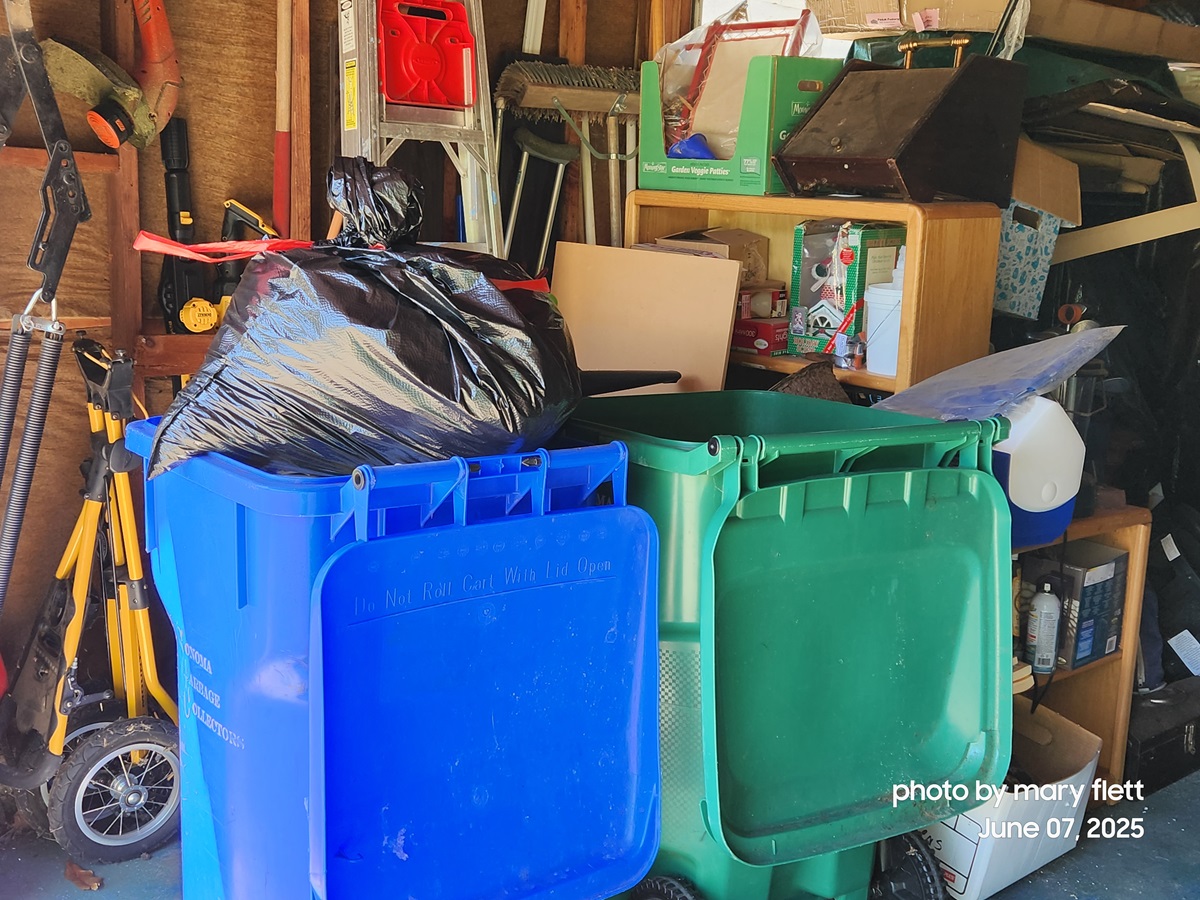
Some objects are very easy to release—I’ve filled several recycling bins with stuff I couldn’t care less about. Then there are other items I go back and forth with. I’m just not ready to let go. This also applies to the memories and emotions I’m attached to that are triggered by the objects. It’s truly a complicated weave!
But the whole tapestry, when looked at now, allows me to appreciate what went into its creation while simultaneously giving me permission to let it go.
Habits Handed Down to Me
My grandparents and parents lived through the Great Depression. The habits of saving aluminum foil, rubber bands, and scraps of paper were deeply impressed on me, and I continue this legacy. At least I recognize the origin, even as I dutifully collect but never use them again.
Other habits include holding onto cards and letters. There’s something intimate and poignant about reading these now. They remind me of people I knew and trigger memories of their voices.
More often than not these bring happy memories to mind. Sometimes, though, they hit a tender spot—experiences and emotions covered over but not healed. When this happens, I can use the opportunity to revisit and reframe. In so many cases, I appreciate how much I have grown and how I have changed. More of what I can let go.
Stuff, Stuff, and More Stuff
I had a friend come with me when I went back to clean out my family home. Mind you, the house had been in the family for three generations, so there was considerable accumulation. I couldn’t have done it alone, there were too many memories and too much stuff.
We went through boxes, cartons, drawers, trunks, and closets. The more we opened, the more we found. What was so wonderful about this incredibly emotionally challenging task was that I got to tell stories about my family to someone who had never known them.
This was the heart of the cleaning out.
It’s All About the Stories
The objects really weren’t all that special—they were just plates and glasses, pictures and books, linens and tablecloths. What made them special were the stories that were attached!
The stories about holiday celebrations. The tales of going to art shows and buying art from far-away places. The memories of sitting with grandmothers and aunties who were tatting and working needles on embroidered napkins and pillowcases. The attachment here was released with the telling, actually freeing the object of the story it contained and freeing me of the attachment to the emotions.
I Have Stories to Tell
One of the saving graces for me as a solo ager is that I’m also a writer. I have a way to share the stories attached to my objects. Living in a digital age, I can now just turn on my phone, record myself, and preserve for posterity the stories of the objects in my surroundings.
I don’t know who the audience will be—if there will even be an audience—but I’m making this part of my negotiations with attachment.

6 responses to “Out With the Old”
Mary,One of the gre
It’s definitely the story attached to objects. Perhaps we are afraid at this point in our lives that if we release the object we’ll forget the story?
Thx for framing the necessary task of decluttering with reminiscing.
A couple of years ago in a cleaning binge I gave away my library of old albums… including jazz ablums from the 60s. I have regretted it ever since. So maybe we should give ourselves some permissions to keep stuff that can’t be replaced and an empty space does not do it..
Totally agree — I’m still holding on to mine as well as still having a record player!
Great article.