Changing Our “Picture” of Old
Maybe it’s just me, but it seems like a lot of folks who I grew up admiring are leaving the planet in droves. Somehow these contemporaries all seem too young to be dying, yet, when I read their obituary, I am amazed to see that they are in their 80s, 90s, or even have met or passed the century mark.
This brings up my own sense of just how “old” I am. I know my chronologic age, but, as I have written elsewhere, that number bears little resemblance to my “felt” age, which can range from my 50s to 80s depending on how tired I am or how badly my joints hurt.
Benchmarks of Aging
We live in a society where benchmarks of aging are common. Here in the U.S., 16-year-olds are eligible to get driver’s licenses. Turn 18, and you can register to vote. Celebrate your 65th birthday, and you become eligible for Medicare.
These are the bookends between which you are expected to become a contributing member of society, have a job, get married, have children, and then find fulfillment in your career. After that, however, only one benchmark remains: death.
The Way We Were
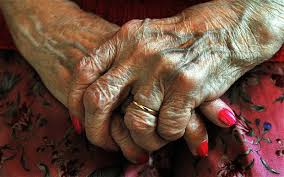
That has been the traditional arc of life, and it is so rooted in our social fabric that we can all easily pull up images of what each of these stages looks like. For Boomers, teenage years consisted of bellbottoms, long-haired hippies, and mini-skirts. Old age looked like grizzled men, hunched over using a cane, and grandmothers in flowered dresses with knee-highs. Both had gray hair, walked slowly, and licked their fingers when trying to turn the page of a newspaper.
These images were reinforced in movies, theatre, and on TV. I suspect you can easily call to mind Ruth Buzzi and Arte Johnson (Gladys and Tyrone) or Tim Conway and his Oldest Man sketches on the Carol Burnett Show. And if you can’t, you can find them on YouTube. And then there’s the Golden Girls.
Who Were My Models of Aging?
My maternal grandfather lived to be 86. He was the most influential role model for me. He remained cognitively intact until he died. He was in a wheelchair for a good portion of his later years due to having fallen and broken his hip. That he survived as long as he did, as well as he did, is testament to his genes and determination to adapt to his limitations. His final decline came about after a stroke in the 1970s. After discharge from the hospital, he was sent to what was then a brand-new way of caring for aging adults — a skilled nursing facility.
I learned how to age with dignity from my grandfather. In spite of his being confined to a wheelchair, he remained socially engaged, a devout Catholic, and a caring, loving force in my life. He accepted what happened to him with grace and humor, and adapted to his changing levels of functioning over time.
Shifts in Perspective
In contrast to my grandfather’s arc of life, my husband died at 76, and the comments made after his passing included, “He was so young!” From a purely chronological perspective, both were “old men.” Yet both possessed a zest for living that belied their chronologic age.
Another difference is that these men were in different generations. My grandfather was born in the 19th century; my husband in the 20th. Life expectancy for a male in my grandfather’s generation was the low to mid 40s because so many infants and children died young. Those who did survive made it into their 60s. By my husband’s generation, better healthcare, improved nutrition, and the eradication of diseases that had once cut lives short had pushed lifespan higher still — and it has kept climbing in the decades since. If anything, 76 should look younger to us today than it would have to my grandfather’s generation.
And yet the picture of “old” hasn’t moved. My grandfather spent his last decade in a wheelchair, increasingly dependent on others for his daily care. My husband, by contrast, was vital, engaged, and largely self-sufficient almost until the day he died. By any functional measure, my husband was the one who had not yet become “old” — but by the calendar, he was the one people called too young to die, while no one questioned that my grandfather, ten years his senior and a decade into physical decline, belonged in the category of “old man.” What that tells me is that our inner picture of old was never really about the number. It was about the wheelchair, the decline, the dependence — and it has stayed exactly the same even as more and more of us are living longer, healthier lives that don’t fit it.
What Stayed the Same
In spite of this incredible shift in lifespan expectancy, what has stayed the same is the unquestioned stereotypical picture of an old person as being someone who is out of touch, physically limited, and no longer competent to make decisions or care for themselves.
This is ageism: this inner role model of what it means to be “old.” Yet the experience I feel, and that is commonly shared with me by my peers, is one of being vital, involved, engaged, and physically able to do many things.
Yet media perpetuates images and memes of frailty and incompetence. And, honestly, I do it myself. I have to really be careful that I don’t dismiss my own abilities by saying to someone, “I’m just an old lady!”
Looking for Evidence
What brought me to this was looking at all the pictures of Dolly Parton, age 80, who was active, vibrant, and anything but “old” (there’s that inner image again)!
I am sharing a list I asked Claude to pull together for me of prominent people who had died since January, along with their age at death. I challenge you to look over this list and see how many of these people fit into that image of “old” that you carry around in your mind.
| Name | Age | Notability |
| Alan Greenspan | 100 | American economist, Federal Reserve chairman (1987–2006) |
| Betye Saar | 99 | American artist and educator |
| Len Deighton | 97 | English spy novelist (The Ipcress File) |
| Zhu Rongji | 97 | Chinese politician, premier of China (1998–2003) |
| Yayoi Kusama | 97 | Japanese artist known for polka-dot and infinity installations |
| Frederick Wiseman | 96 | American documentary filmmaker |
| Gladys West | 95 | American mathematician, GPS pioneer |
| Robert Duvall | 95 | American actor (The Godfather, Apocalypse Now) |
| Sonny Rollins | 95 | American jazz saxophonist |
| Duane Michals | 94 | American photographer |
| Clive Davis | 94 | American music executive |
| Nancy Kassebaum | 94 | American U.S. Senator (Kansas) |
| Valentino | 93 | Italian fashion designer |
| Edward Hoagland | 93 | American novelist and essayist |
| Paul R. Ehrlich | 93 | American biologist and educator |
| Tony Brown | 93 | American journalist and television producer |
| Holmes Rolston III | 92 | American philosopher, pioneer of environmental ethics |
| David Malouf | 92 | Australian poet and novelist |
| Wendell Berry | 92 | American author, poet, and farmer |
| Abdullah Ibrahim | 91 | South African jazz musician |
| Harald V | 89 | King of Norway (1991–2026) |
| David Hockney | 88 | English painter and photographer |
| Anthony J. Leggett | 87 | British physicist, 2003 Nobel laureate in Physics |
| Ted Turner | 87 | American media entrepreneur, founder of CNN |
| Wally Funk | 87 | American aviation pioneer and astronaut |
| Claudette Colvin | 86 | American civil rights pioneer |
| Neil Sedaka | 86 | American singer-songwriter |
| Ali Khamenei | 86 | Iranian Supreme Leader (1989–2026), former president of Iran |
| Mary Rand | 86 | British Olympic gold medalist, long jump |
| Barney Frank | 86 | American congressman, co-author of Dodd-Frank Act |
| Aldrich Ames | 84 | American ex-CIA officer, convicted Soviet/Russian double agent |
| Jesse Jackson | 84 | American civil rights leader and politician |
| Umberto Bossi | 84 | Italian politician, founder of the Northern League |
| David Clayton-Thomas | 84 | Lead vocalist, Blood, Sweat & Tears |
| Robert Mueller | 81 | American FBI director (2001–13) and special counsel |
| Michael Tilson Thomas | 81 | American conductor and composer |
| Nedra Talley | 80 | American singer, member of the Ronettes |
| Dolly Parton | 80 | American country music singer-songwriter |
| Tim Curry | 80 | British-born actor (The Rocky Horror Picture Show) |
| Biruté Galdikas | 79 | Primatologist and orangutan conservationist |
| Bob Weir | 78 | American musician, co-founder of the Grateful Dead |
| Bud Cort | 77 | American actor (Harold and Maude) |
| Willie Colón | 75 | American trombonist and salsa music pioneer |
| Victor Willis | 74 | American singer, lead vocalist of the Village People |
| Sheikh Hamad ibn Khalifa Al Thani | 74 | Former Emir of Qatar (1995–2013) |
| Catherine O’Hara | 71 | Canadian actress and comedian (Schitt’s Creek, Home Alone) |
| Lindsey Graham | 71 | American U.S. Senator (South Carolina) |
| Scott Adams | 68 | American cartoonist, creator of Dilbert |
| Afrika Bambaataa | 68 | American DJ, hip-hop pioneer |
| Ali Larijani | 67 | Iranian politician, de facto leader after Khamenei’s death |
| Abdul Ahad Mohmand | 67 | Afghan pilot, first Afghan in space |
We Are the New Role Models of Aging
Here’s the take-home message. We need to replace the images of aging we carry around inside and accept the fact that we are the new models of aging. Our children and grandchildren are experiencing a lifespan increase that is unique because there are so many of us living longer and living healthier lives across that span.
Who you are now, regardless of your chronologic age, is being watched, imitated, and absorbed by your children and grandchildren. How you think, how you make decisions about your future, the meaning you give to your present, and the value you place on your past will become the roadmap of aging for them.
My suggestion is that you explore your own inner image of “old.” Take a look in the mirror and see if any of those characteristics show up. Then put that old image in a virtual picture frame and embrace the new model of how you are redefining what it means to be old.
Click here to watch my video essay on “What Is Old?”

Leave a Reply