

The Future of Healthcare
I have been on a one-woman crusade for several years now trying to show people the light as to why they should not spend their hard-earned money on Medicare Advantage health plans. In spite of my efforts, the “Big-Three” for profit health insurance companies (UnitedHealth Care, Elevance (AKA Anthem), and CVS/Aetna) posted record profits in this last quarter.
Yet, each of them is taking a hard look at their profit margin and making decisions to pull out of a number of states altogether. Why would they do that, given their recent gains? Well, turns out insuring people is more like playing the stock market than actually meeting the healthcare needs of folks.
To my mind, this is an indicator of the demise of healthcare as we know it. It is financially unsustainable, it is unequal in access to treatment and care across the nation, and it satisfies only one industry – the insurance industry – leaving the rest of us frustrated and angry.
The Business of Health Care
Healthcare insurance companies are in the business of risk management, not healthcare. If you understand that, you can make better decisions on where your increasingly smaller healthcare dollars should go and to whom.
It wasn’t all that long ago that most Americans had to pay cash for doctor visits, hospital stays, and medications. A few lucky folks, mostly union members, were covered by insurance policies paid for by their employers. This all changed when President Johnson signed the Medicare Bill in 1965.
That Act brought the government into the picture and created systems for folks 65 and older that covered hospital stays and limited out-patient services including doctor’s visits and some vaccines.
From its beginnings, Medicare has been a bone of contention. It was a compromise plan, as all enacted laws in this country are, but its positive impact on the health of older Americans was profound. One flaw that was never rectified was the exclusion of coverage for hearing aids, glasses, dental needs, and medications.
Legislators, lobbyists, and the American Medical Association have been tinkering with it ever since it was signed into law. President Nixon expanded coverage to include people with long-term disabilities and end-stage kidney failure (1972). President Clinton created Part C (1997), opening the market to for-profit insurance companies. President Bush added coverage of medications (Part D) in 2003.
Pause Here for a Moment
If you are a Boomer like me, consider for a moment how the arc of health insurance coverage during our lifetime has gone from our parents having to pay out-of-pocket for any visits to the doctor or paying for hospital emergency treatments, to our current payment system that includes cutting edge vaccines, cancer treatments, and repair and replacement of almost every organ and joint in our bodies.
Our grandparents didn’t have any federal health coverage at all, and if they needed to be hospitalized as they grew old, they had better have put money aside or they were just out of luck!
By the time we were graduating college, starting families and/or careers, unless our employer offered health insurance as an employee benefit (and not very many employers did!), you just did your best to stay well and out of the hospital. For many of our generation, paying for babies was the first encounter with medical debt!
It wasn’t until we were well-established adults that health insurance coverage was an expected benefit of being employed, and offered by all but the smallest companies. And now we take it for granted and complain about monthly premiums.
Boomers and Retirement
When Boomers started hitting retirement age, Medicare was ready and waiting for us. We had paid into Social Security, and our matching contributions to Medicare had built up into a tidy sum. This trust fund had been watched over carefully and preserved in order to make sure that healthcare would not be an issue for us in our “golden years”.
In 1984, President Ronald Reagan began borrowing from the Social Security Trust Fund to address federal General Fund deficits. At that time there was actually a surplus in the Social Security Trust Fund, and so it was low-hanging fruit.
And while the Government continues to borrow against the Trust Fund, it does pay back what it borrows with interest. Still, an imbalance exists, since more benefits are now being paid out of the Trust Fund, as there are more Boomers collecting.
Between Then and the ACA
As originally conceived, Medicare Part C, now commonly called “Medicare Advantage”, was a plan where the federal government authorized Medicare to “contract with risk-based, private health plans, or those plans that accept full responsibility (i.e., risk) for the costs of their enrollees’ care in exchange for a prospective, monthly per-enrollee payment.” (McGuire, T.G., Newhouse, J.P. And Sinaiko, A.D. (2011), An Economic History of Medicare Part C. The Milbank Quarterly, 89: 289-332. https://doi.org/10.1111/j.1468-0009.2011.00629.x).
The hoped-for outcomes were lower costs to enrollees (you and me), more choices, and better healthcare efficiency (“bundled services”) between plans. From the beginning, remember, this program was offered as an alternative to traditional Medicare. It was designed to pay insurance companies additional money to care for folks 65 and older who would choose to pay out of pocket, over and above what they had already contributed to Medicare over the years. What a great deal for the insurance companies!
The Affordable Care Act
Fast forward to 2010. The Baby Boomers were beginning to retire. The largest generation ever was now starting to collect benefits. They had good reason to expect that their promised care would be there. They had every reason to expect they would have choices of healthcare providers, hospitals, pharmacies, and clinics. They had every reason to assume their healthcare needs would be reasonably priced, available in their community, 24/7, and the envy of every other health system in the world.
Small problem. The projected costs, and therefore the accumulated savings that should have been available to pay for all this coverage, fell short. Turns out, expectations could no longer be met. Turns out, hospitals were cutting back on services, providers couldn’t afford to stay in practice, drugs were prices way too high, and co-pays were growing.
The For-Profit Business of Health Was Booming
The insurance companies had found a cash cow. Large managed care health organizations had created systems that maximized profit while slimming down payment for providers and limiting care. The government hemmed and hawed and stonewalled their way into creating an unsustainable system for payment, approval of new services and pharmaceuticals, and continually played Jenga with provisions of care that had been put in place to provide for the most vulnerable among us.
Then the pandemic hit.
The pandemic gave insurers and hospital systems even more cover for the trends already underway — telehealth expanded rapidly, smaller hospitals and independent practices were swallowed up by larger systems, and Medicare Advantage enrollment surged as insurers ramped up marketing to homebound older Americans.
It is my contention that Congress has never found its way out of the pandemic. Leadership is absent, powerful lobby groups hold sway over legislators, and state and local distribution systems of grants and funding to non-profits are calcified and without recourse except to await the latest budget cuts and try and make do.
How Does This Impact Healthcare?
Medicare Advantage plans have turned out to be great if you are healthy and stay that way. You get lower premiums and the insurance companies make good money off of you. It is not such a good deal if you have conditions that require treatment by more than one provider, or have chronic conditions, or if you are met with unexpected illness or accident and require specialized care that you didn’t get pre-authorized.
This is putting a higher number of eligible Boomers at risk who have become used to paying low monthly premiums. Now we are finding out that we don’t have choice, we need to wait to receive care, and sometimes we are denied services altogether.
The insurance companies, on the other hand, are laughing all the way to the bank. They continue to maintain their profit margins by pulling out of areas of the country where people are actually using their benefits, thus costing the Plan money. “As people leave the Marketplace, insurers may reassess the profitability of their Marketplace participation and more may decide to pull out in the future, either fully or in select states.” (https://www.kff.org/affordable-care-act/how-has-insurer-participation-in-the-aca-marketplaces-changed-in-2026/).
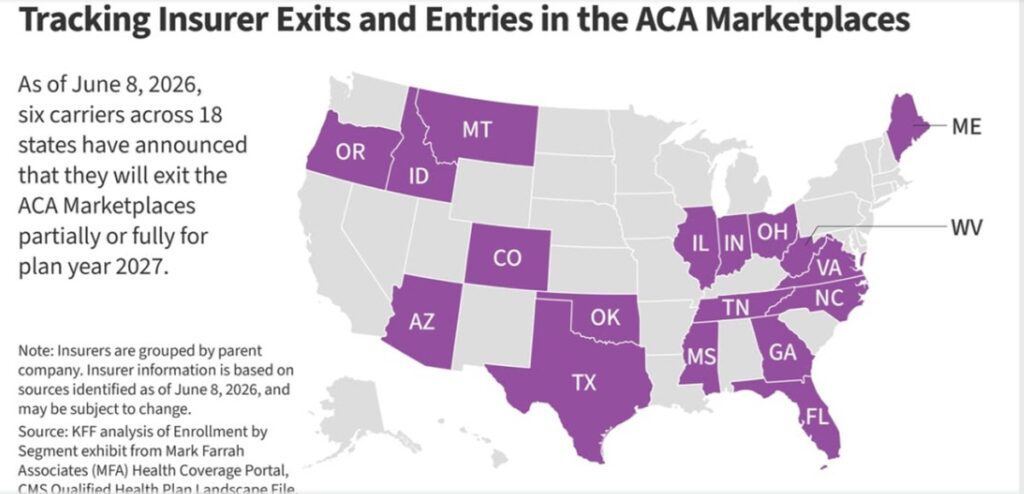
According to this same KFF report, six health insurers have announced they will exit ACA Marketplaces in 18 states next year, potentially leaving hundreds of thousands of ACA enrollees with fewer insurance options.
We Are at a Crossroads
Dusting off my crystal ball, I am fairly confident that several things will happen in the next five years. Boomers will organize and demand that healthcare be nationalized. Physicians and other healthcare providers will organize into unions. These will expand to include caregivers. Insurance companies will completely pull out of the Medicare Advantage marketplace and find another way to make money off of illness without government interference.
Healthcare will change from a fee-for-service model to an incentive for staying healthy model. The majority of services will be delivered outside of medical facilities. Anchor institutions like hospitals will turn into multi-use centers where the focus will be on prevention and preservation of health. Those needing emergency care will still be treated in emergency facilities, but quickly returned home where post-emergency care can be monitored and continued outside of a hospital.
Payment for all of this will come from equitable taxation of individuals, employers, and corporations.
Stay tuned — my crusade isn’t over yet!


3 responses to “The Future of Healthcare”
Terrific historical review of the USA’s scandalous “kleptomaniac-by-the-rich” health “care” “system!” Several times reforms have been tried in Congress, to better fund our Social Security Trust Fund. Such reforms — including several modest proposals as to how wealthier people could contribute far more than the paltry “cut-off” amounts they currently pay in, plus several other EASY, not particularly radical fixes. BUT, Republican legislators in particular — gleefully paid lapdogs of the insurance “industry” (and all our federal representative already receiving FREE, GOVERNMENT-paid healthcare FOR LIFE) — have “successfully” sabotaged all such reforms. Their incredibly cynical motto? “Cut off the legs of social security, then call it ‘shortie.’” And then, even more cynically: propose “privatizing” it, which is “code” for: handing over OUR money to wall street — to gamble with, steal and convert into THEIR “profits.”
Similarly, primarily rich Republicans have repeatedly blocked efforts for Medicare to cover seniors vision, hearing and dental costs. Why? Because to such pampered, ageist puppets — for “old people,” VISION, HEARING and EATING are “luxuries.” I thus DO believe there is a special posthumous fate waiting for all those who have so “cleverly” turned Americans’ HEALTH, into just one more profit center for the BHM (Billionaire Hoarders’ Mafia). Here ends my “obituary” on the USA’s elder-hating, multi-decade scandal, utterly out of synch with nearly every other industrial democracy on Earth.
Whether Medicare Advantage or traditional Medicare, seniors have become 2nd class citizens. Health care systems minimize services and Medicare pays less then it costs to deliver optimal healthcare to its providers. This means we need care navigators to identify and advocate for the care that should be provided. In our business friendly government, I don’t see any party willing to say the trust must have more resources or a less expensive system of care. Having Medicare for all would dramatically reduced the cost of care. I don’t see that happening in my life time.
That was an excellent summary history, Mary. Everything you said was true and accurate. However, the missing points are, to my way of thinking anyway, perhaps the most important aspects which lead to where we are now. (1) When the Managed Care Model was first proposed for government insurance programs (i.e.,Medicare and Medicaid), health care was predominantly provided by non-profit entities and the idea was that if organizations who delivered care focused on data about treatment outcomes and the efficacy of preventive measures to support wellness rather than always waiting for problems to become serious acute or chronic conditions the patients would be better off and providers would have more predictability and satisfaction regarding their treatment outcomes. Governments liked the idea that if they paid an organization a per-member premium that was slightly below what their fee-for-service costs were for demographically equivalent patient populations, they would save taxpayer money and the provider organizations would have the incentive to provide better/more effective care because they could keep the money they saved as a result of having better outcomes, which could then be rolled into the provision of even better care for more people. Groups like Kaiser Family Foundation (now known as Kaiser Permanente) was one of the main leaders in the implementation of this concept and made it work well for many years. The problems with this model include: (a) patients don’t like having their options limited; (b)documentation/data collection/data analysis takes time and effort and can be costly, and the personalities of providers and researchers self-select for different roles, so it is difficult to get people to actually do what is needed to make the model work as it was intended. (2) During the George H W Bush years, there was a lot of Republican talk about the need for non-profits to operate “more like businesses” because they “cared” but were “inefficient” (not really true, but it made a good sound byte and served the intended purpose of opening the door to for-profit privatization of the health care industry and government functions). So, by the time Clinton signed off on Medicare Part C for-profit insurance and health care models were taking over the industry. (3) The profit motive in “business” creates perverse incentives for health care organizations. The goal shifts from achieving positive health outcomes for patients to making money for corporations and shareholders. Quality of care drops and the focus shifts away from finding cures to promoting maintenance of chronic conditions. Overhead costs are reduced through the reduction of staff, services and patient contact time. As you and I have discussed before, I firmly believe that certain things should NEVER be for profit. Health care is one of those things.